
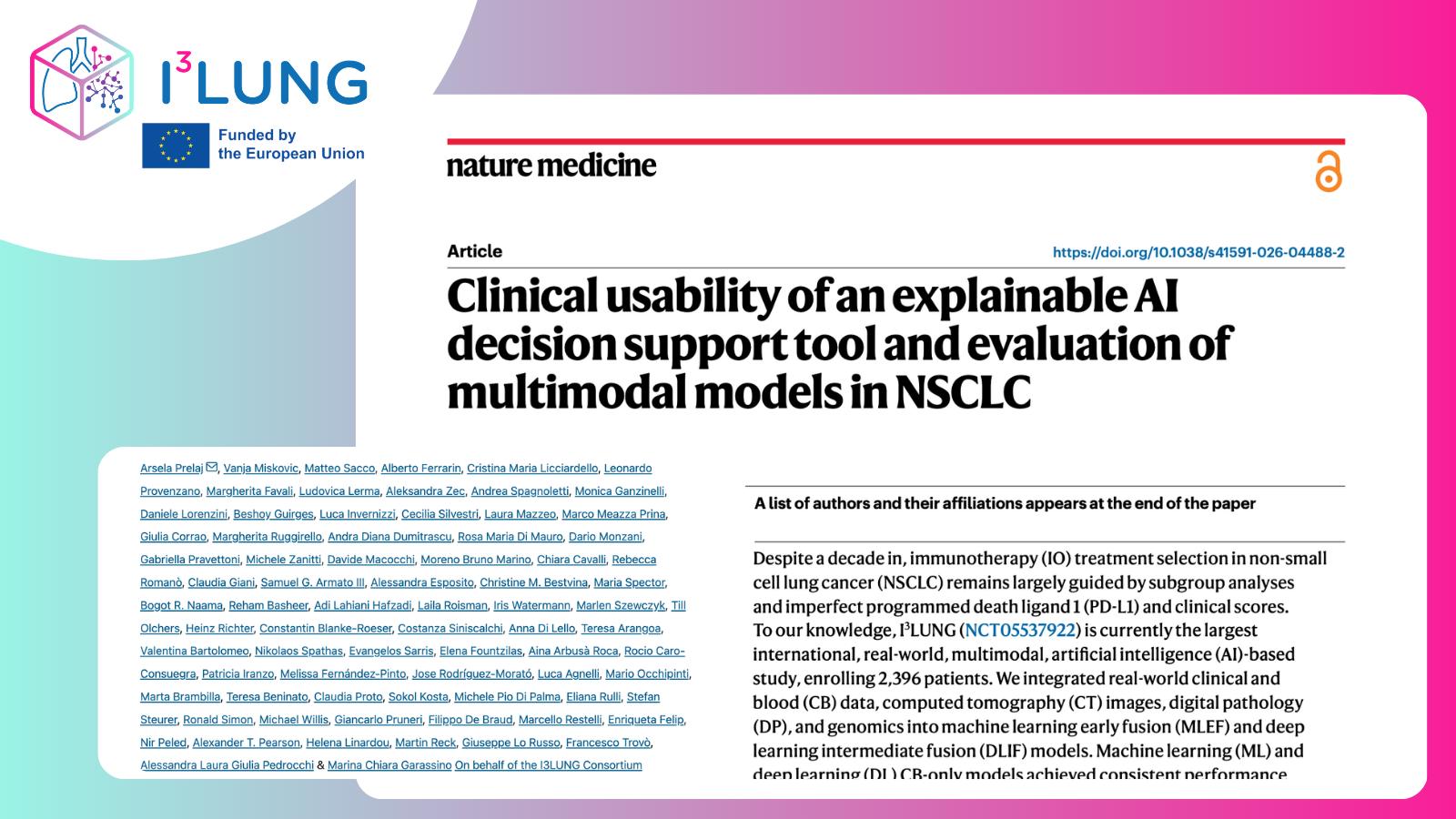
I3LUNG has been published in Nature Medicine
Four years of work.
2,396 patients.
And now, one very special milestone: 𝗜𝟯𝗟𝗨𝗡𝗚 𝗵𝗮𝘀 𝗯𝗲𝗲𝗻 𝗽𝘂𝗯𝗹𝗶𝘀𝗵𝗲𝗱 𝗶𝗻 𝗡𝗮𝘁𝘂𝗿𝗲 𝗠𝗲𝗱𝗶𝗰𝗶𝗻𝗲. 🎉
The study brings together clinical, imaging, pathology, genomic and AI data to investigate whether multimodal AI can help predict outcomes for patients with NSCLC receiving immunotherapy.
But perhaps the most interesting question was not simply: “Can AI predict?”
It was: “Can AI actually help clinicians make better predictions?”
In our clinical usability study, both lung cancer experts and non-expert physicians improved their predictions when supported by an explainable AI tool.
For I3LUNG, this is an important distinction: the goal is not AI replacing clinical expertise, but AI becoming a useful, explainable partner in clinical decision-making.
And the story doesn’t end with this publication: Prospective validation of the I3LUNG decision-support system is already ongoing in more than 2,000 patients. 🚀
𝗔 𝗵𝘂𝗴𝗲 𝘁𝗵𝗮𝗻𝗸 𝘆𝗼𝘂 to all the patients, clinicians, researchers, institutions and collaborators who made this work possible, and to the entire I3LUNG community for turning a very ambitious idea into a great project and framework for future research in multimodal AI!
Read paper here.
Stay tuned for more information and don’t forget to follow us on our social networks:
LinkedIn | Twitter | Instagram | Facebook
Share on: