
As mentioned in our previous article, the kick-off meeting on July 1-2 officially started the EU I3LUNG Project. Let’s dive deep into the first day!
Friday, July 1st
The meeting started with the introduction of the project background and an update by the principal investigator (PI) of the I3LUNG, Arsela Prelaj (Istituto Nazionale Tumori of Milan – INT). Then Melissa Fernandez from MEDSIR, the company leading WP1 (Project Management and Coordination) and managing the trial coordination, explained MEDSIR’s initial support to the I3LUNG project, drafting the proposal and its submission to the EU portal.
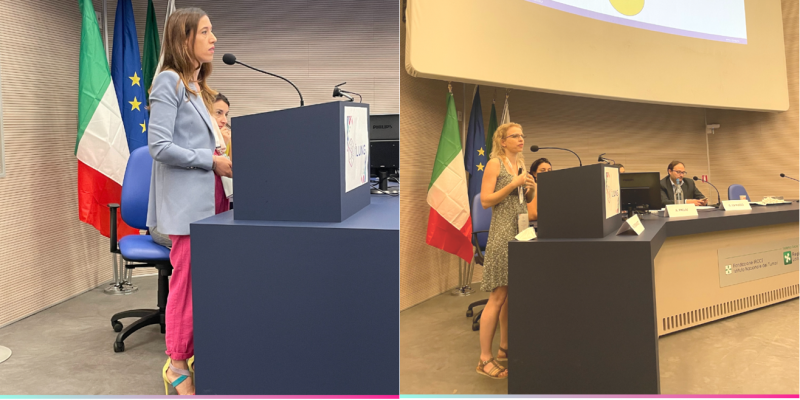
(From left to right: Arsela Prelaj and Melissa Fernández)
For the development of this patient decision-making treatment AI-technology, a wide range of information from around 2,200 patients, retrospective and prospective, will be captured and integrated in the AI-system (WP3, Data Capturing and Integration). Different partners from Greece (Nikolas Spathas, Metropolitan Hospital), Germany (Lung Clinic Grosshansdorf; Guido Sauter from University Medical Center Hamburg Eppendorf), Spain (Ramon Amat, Vall d’Hebron Institute of Oncology), Italy (Monica Ganzinelli and Elsa Tagliabue from Istituto Nazionale dei Tumori; Laura Brunelli from Istituto di Ricerche Farmacologiche Mario Negri) and Israel (Laila Riosman from Shaare Zedek Medical Center) explained how molecular data will be collected and analyzed in this work package. This includes collection of clinical data, pathological analysis and molecular profiling of the cancer immune environment, characterization of genomics and immune related transcriptomics, metabolomics, circulating biomarkers of response or progression, microbiome profiling and radiomics.
Patient centricity is one of the key novelties in the I3LUNG project, and for the creation of the IPDAS, different partners involved in WP4 (Patient’s quality of life – QoL – and Psychological Impact of AI on Medical Decision-Making) discussed about their specific implication in this part of the project:
- Emilia Ambrosini, from Politecnico di Milano, introduced the Sensor-based monitoring system of QoL
- Roberta Grasso from European Institute of Oncology, leading WP4, provided a general overview of how the introduction of specific psychological assessments during treatment administration can impact quality of life and decision making of patients.
- Alfonso Aguaron, representing the patients association Lung Cancer Europe, introduced specific topics related to patients recruitment.
The first day continued with more technical sessions. All the different patient-level data generated and gathered during the project have to be processed (WP5, Knowledge Extraction). The evaluable features will be extracted and delivered to the next collaborative groups for the AI algorithm design describing the real-world landscape and final model building.
- Sokol Kosta, from Aalborg University, explained how the different data gathered in the study will be integrated to generate the DIRS.
- Alexander Pearson, from University of Chicago (leading WP5) explained how to extract evaluable features on patient-level data generated from WP4 to pass forward for integrative modeling under WP6.
Francesco Trovó and Laura Pedrocchi from Politecnico di Milano, leading WP6 (Learning and Reasoning) and WP7 (Explainable AI), finally introduced the concept of AI/ML modeling and model explainability, respectively, highlighting the methods that enables humans to understand, appropriately trust, and effectively manage machine learning models while maintaining a high level of learning performance.
This intense first day ended with a pleasant dinner at a beautiful restaurant in Milan next to Duomo, where the attending representatives from the 10 WP had the chance to chat and get to know each other.
Let’s see what happened in Day 2 of the kick-off meeting!
I3LUNG is a collaborative, 5-year, 10M€ EU-funded project aiming to create an artificial intelligence (AI)-based personalized decision-making tool to aid both clinicians and patients in selecting the best lung cancer treatment plan.
The consortium behind this project comprises 16 international partners, recognized companies and institutions located worldwide, whose miscellaneous expertise in clinical trial, molecular analysis, biology, AI, psychology, ethical and business will permit the realization of this ambitious project.
The partners will collaborate on different steps for the generation of a patient avatar, able to predict progression and outcome of each individual patients, accomplished through the following:
- By supporting the physicians’ decision-making process by creating an AI-based Physician Decision Support System (PDSS) to provide an easy and ready-to-use access to predictive models, increasing care appropriateness, reducing the negative impacts of prolonged and toxic treatments.
- Facilitating important healthcare costs offsets by selecting the best personalized treatment.
- Empowering patients with an Individualized Patient Decision Aid System (IPDAS) for co-decision and reinforces research with a Data Imputation and Retrieval System (DIRS) to make securely available the data gathered during the project.
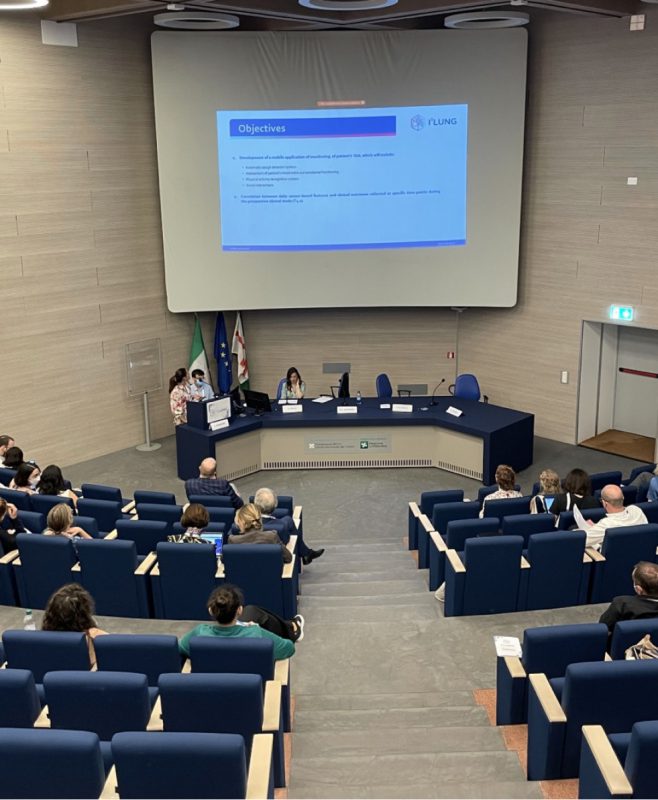
Following contract signature, the 16 partners met for a kick-off meeting on July 1 and 2 in Milan, in order to know each other face-to-face and organize the next steps and upcoming milestones of the project. This two-days intensive session was part of the project initiation phase, that brought together all the interdisciplinary teams involved to share information, align objectives and get to know each other.
Leading persons of each work package (WP) introduced their research centres, project teams, role, and responsibilities, as well as the individual and common project goals and objectives.
Let’s read in the next article how July 1st and 2nd went in details!